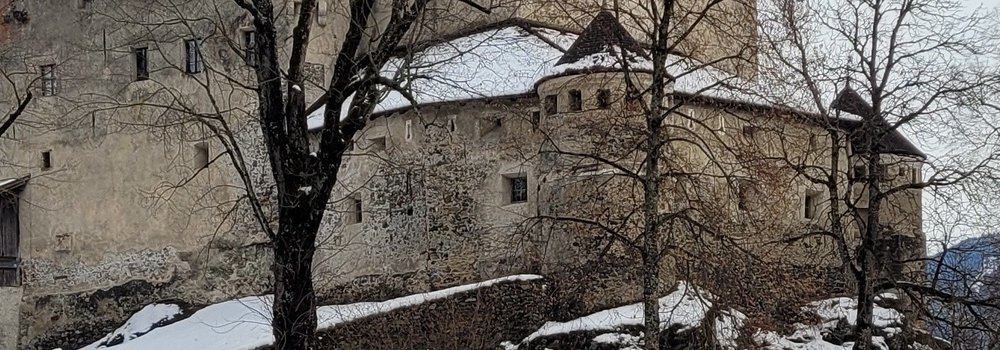
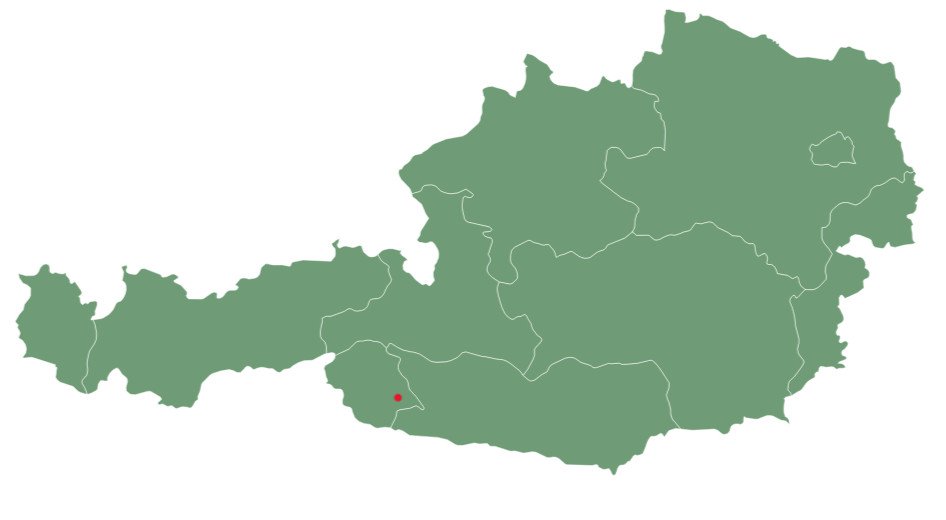
Lienz in Eastern Tyrol, Bruck Castle © simplemaps.com
In 1501, a series of inventories of the entire property of the Counts of Gorizia were created. With the death of Leonhard as the last member of his dynasty in 1500, the inheritance passed to the Habsburg dynasty.✱ Maximilian I, now governor of these extensive lands, decided to sell some of the Gorizian estates, including the manor of Lienz with Bruck Castle, their former residence. With the handover to the new owners, the Barons of Wolkenstein-Rodenegg,✱ the rooms of the castle were inspected, and all remaining possessions were recorded.✱
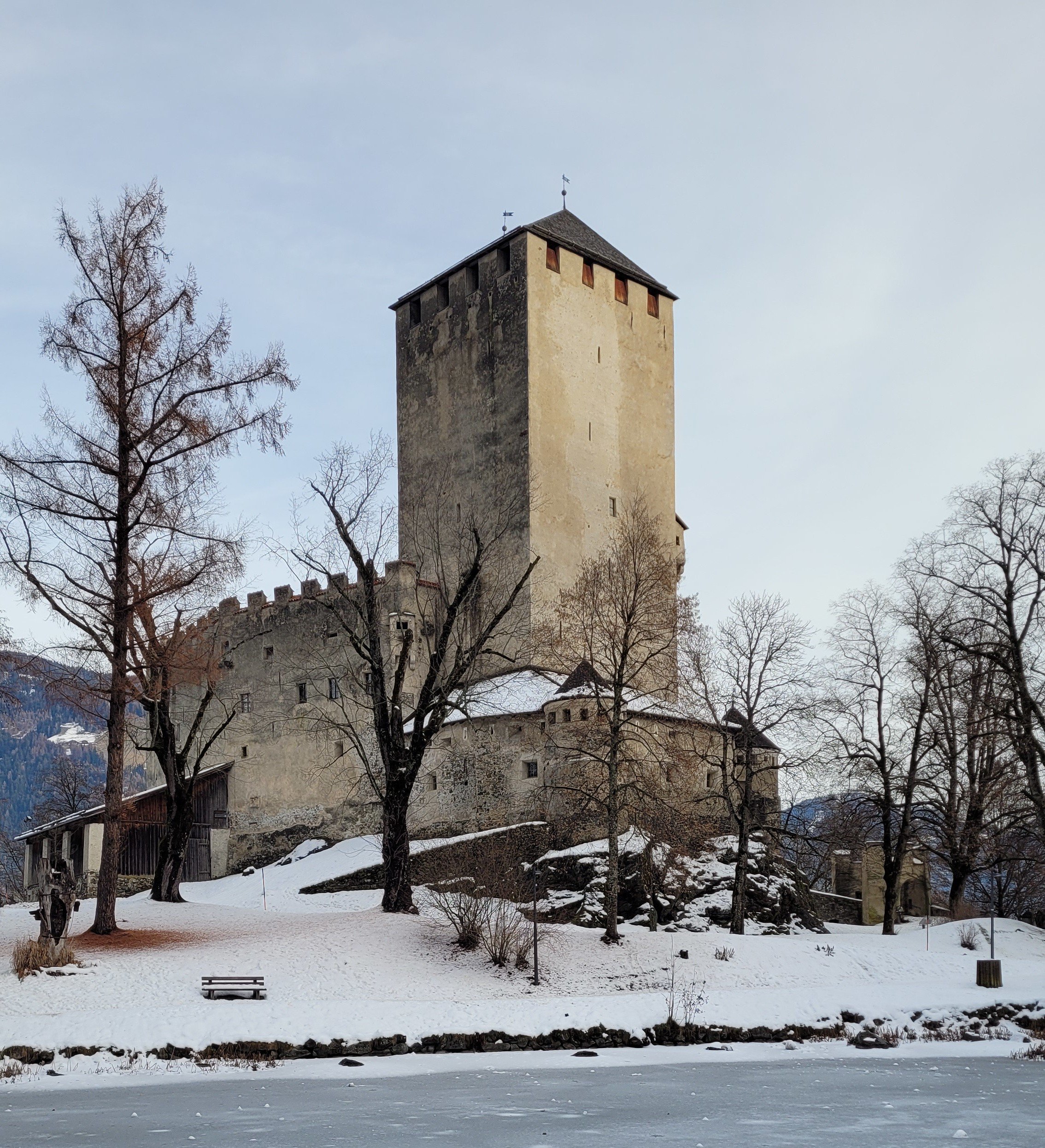
Bruck Castle (2023). Image © Elisabeth Tangerner
This inventory of movable goods at Schloss Bruck is of particular importance, for it offers a glimpse into a magnificent household of princely proportions. The objects tell of a flourishing courtly life, with music, games, hunting, and an interest in the arts of healing. The furnishings and treasures in the women’s chambers are particularly noteworthy.✱ These rooms were the home of Leonhard’s wife Paula Gonzaga until she died in 1496. The dazzling lifestyle reflected in this inventory and others of this collection can be traced back to her family background living in the Palazzo Ducale in Mantua, as can be seen from her bridal treasure inventory.✱
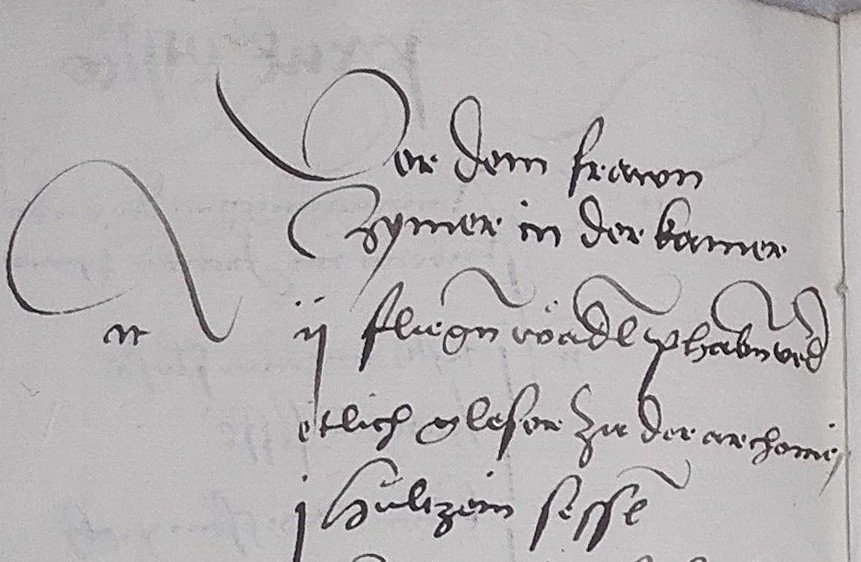
“Vor dem frawn/zymer in der kamer. [...] Etlich gleser zu der archomei.…”
AT-TLA/BBÄ MIB Inventare, A 203.1, fol.2v. Image Tobias Pamer © TLA/INVENTARIA
In a chamber alongside the women’s wing of the castle, there is a group of objects that attract particular attention: several glass vessels for alchemy. They are mentioned together with other objects that may be associated with the art of alchemy (here: archomei) in the courtly life of this castle, such as an alembic (distilling helmet) for the production of certain liquids, located in an adjacent room. Alembics are relatively common throughout the DALME collection.
These two items are not the only indications that objects for special practices—the production of medicine and cosmetic products or maybe even alchemical experiments—were handled in this residential castle, since archaeological evidence also supports this assumption. During several excavation campaigns carried out by the University of Innsbruck in 1999, fragments of some artifacts found in the castle moat and in two vault spandrels inside the castle may have been used for this kind of purpose or even point to the existence of an (alchemical) laboratory in the 15th and 16th centuries.✱
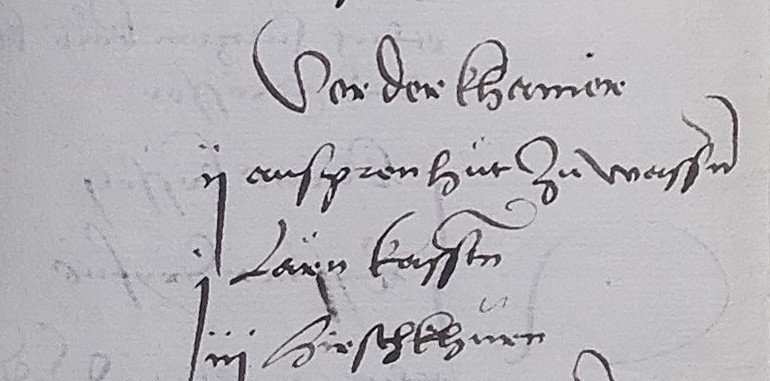
"Vor der khamer. II auspren hüt zu wassern.…” AT-TLA/BBÄ MIB Inventare, A 203.1, fol.2v. Image Tobias Pamer © TLA/INVENTARIA
These are part of the group of small finds that were presumably disposed of as rubbish or used to fill cavities during construction work.✱ The findings contain test bowls,✱ graphite crucibles✱ and a small bowl made of pressed ash for the practice of cupellation,✱ which could be assigned to a use in a laboratory. A potential link to the inventory is provided by the following items: A ceramic lower part of an alembic with a collecting channel,✱ parts of spouts also belonging to this distillation device, as well as glass vials and small tubes.✱
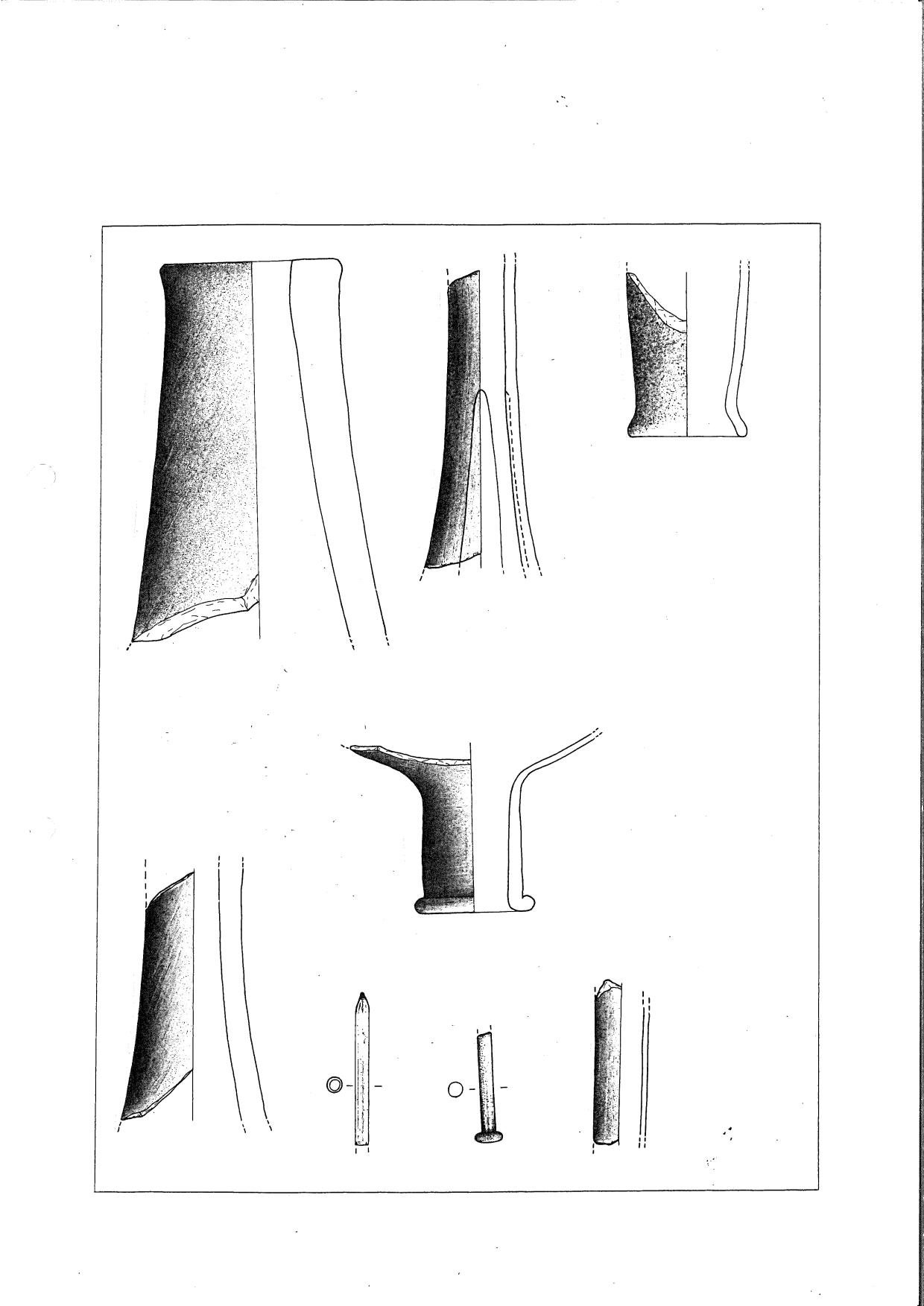
Fragments of spouts, probably parts of the upper part of an alembic. Image © Museum Schloss Bruck
One cannot know whether the fragments are exactly those that were examined and recorded in the course of compiling the inventory. There is also a final uncertainty in the attribution of the excavated objects; their context of use is ultimately speculative. However, both written and material records indicate that the ownership and usage of special vessels and distilling helmets—for whatever purpose—was part of courtly life at Bruck Castle in the 15th century.
Who used these objects and what they intended to do with them remains a mystery. That said, an undated inventory from either the 14th or 15th century lists one item suggesting that the Counts of Gorizia had a long tradition of alchemical practice. Situated between tablewares and textiles we come across two glasses assigned the attribute “haidnichw̑.” If this addition corresponds to the word heidnisch (Eng. pagan), it could suggest that the glasses were used for alchemy, since the description implies a devaluation of these practices (i.e., diverging from Christian doctrine).✱ This is also supported by the subsequent mention of a mortar, a device commonly found in inventories from the period. Mortars were used in the kitchen but could also be used as a tool for alchemy.✱ However, it is important not to make any hasty categorizations, as the attribute “pagan” could also have other meanings, such as that the object is something unknown, maybe even originating from earlier times or foreign parts of the world.✱

"Und II haidnichw̑ gleser und I morser.“ AT-TLA/BBÄ MIB Inventare, A 1.31, fol.1r. Image Elisabeth Tangerner © TLA/INVENTARIA
The fact that the glasses for alchemy (“gleser zu der archomei”) and the alembic (“auspren hüt zu wassern”), mentioned in the 1501 inventory, were kept in the immediate vicinity of the women’s chambers is not in itself proof that the women—Countess Paula herself or someone from her entourage—were involved in the making of cosmetic or medical products or even alchemical experiments. The inventory merely confirms that these objects existed and were valuable enough to be recorded. The description also suggests that the person who made the inventory knew at least rudimentarily what these objects were for: the glass vessels were explicitly intended for special practices—as the scribe assumes in the field of alchemy—and the alembic for distillation of liquids.
Nevertheless, it is quite conceivable that these tools were used by women at Bruck Castle. On the one hand, the castle served only as Paula’s residence; Leonhard lived in the town house,✱ whose goods—as the inventory of Bruck Castle✱ and another specially compiled inventory for the town house show✱—were considered separate. On the other hand, the preoccupation with such practices can be demonstrated in the case of numerous women in the late Middle Ages and the early modern period. Caterina Sforza might have recorded her knowledge in the book Gli Experimenti, which contains recipes especially for medication and cosmetics.✱ Anna von Sachsen shared her fascination for traditional alchemy with her husband August and had profound knowledge in medicine and distillation.✱ In the smear campaign against Barbara of Cilli/Celje, rumors were spread about her machinations in the alleged laboratories in her castles. These accusations devalued not only her as a person, but also alchemy as a blasphemous practice.✱ It has been proven that the possession of several distillery helmets by Eleonore of Scotland—wife of archduke Sigmund of Tyrol and a contemporary of Paula—has often been misinterpreted by researchers as an indication of a possible alcohol addiction. Rather, it is conceivable that the archduchess was involved in the practice of distilling for cosmetic or medicinal purposes.✱
Even among Paula’s relatives, women excelled in this field of knowledge. Her niece Elisabetta Gonzaga, Duchess of Urbino by marriage, is credited in Ricettario galante, a 16th century recipe-book, as the author of instructions for the distillation of roses and lemons.✱ Her nephew’s wife, marchioness Isabella d’Este, was known for producing cosmetic powders, scented oils and perfumes, and was also interested in acquiring medical and alchemical formulas.✱ The surviving correspondence of certain epistolary networks - for example between Caterina Sforza and the Gonzaga court - reveal how recipes could circulate among women. ✱ An epistolary exchange of knowledge and information on such practices can also be found in Paula’s immediate circle, as the edited corpus of her sister Barbara’s correspondence shows. There are several mentions that Barbara was introduced to the production of herbal distillates for medical and cosmetic purposes.✱
Apart from the written and material records mentioned above, there is unfortunately no further information about the production of medicine or cosmetic products or even alchemical practices at Bruck Castle. Even though the 1501 inventory mentions glass vessels for alchemical purposes,✱ a distinction must be made: it cannot be determined more precisely whether alchemy in the proper sense was practiced with these objects, or whether they were used instead for the more likely option of producing medicinal or beauty-enhancing products. It is quite possible that the scribe made an allusion to alchemy because he lacked secure information what the object actually was. Nevertheless, even the remaining clues offer at least a small insight into this specific area of courtly culture in the Renaissance and perhaps also into the female dimensions of knowledge acquisition and production as well as their agency.
About INVENTARIA (FWF P35988)
Christina Antenhofer | Ingrid Matschinegg | Claudia Posch | Gerhard Rampl | Gerald Hiebel
The interdisciplinary project INVENTARIA (2022–2026) is a collaboration between the University of Salzburg (Department of History; IZMF—Interdisciplinary Research Centre for the Medieval and Early Modern Period), the University of Innsbruck (Departments of Linguistics and Archaeology; DiSC – Digital Science Center; FZ Digital Humanities), and the IMAREAL—Institute for Medieval and Early Modern Material Culture in Krems. The project was funded by the Austrian Science Fund (FWF; P 35988, Stand-Alone Project) and led by Christina Antenhofer (University of Salzburg), Ingrid Matschinegg (IMAREAL), Gerald Hiebel, Claudia Posch and Gerhard Rampl (all University of Innsbruck). The main goal of the project team is the analysis and editing of 181 castle inventories from the Tyrolean State Archives (AT-TLA), dating from the 15th and 16th centuries in the historic region of Tyrol, using digital methods for transcription, semantic annotation, and interpretation. We start from the hypothesis that inventories are neither objective nor simple lists of things, but products of an inventory practice, with traces of this activity found both in the texts and in the materiality of the archive records. At the same time they contain a wealth of information on relations between things, people, actions, rooms and the words used for them. With the help of ontological modeling and deduction from the archive records, we make the historical practice of creating inventories visible. How did people go about cataloguing and describing all the objects found in a castle? How did they inspect the spaces, and which spaces were not included? Who was involved in these processes and how was the wealth of large and small pieces of equipment captured in words? —These are the main questions for our interdisciplinary project.
Using the transcription software Transkribus, we apply an ideal model processing path that includes, within a closed digital research environment, transcription, semantic annotation and digital editing. Semantic technologies are used to transform the ontological modeling into formal data structures that allow visualizations and queries of the relations between rooms, objects, individuals and the practices connecting them. The information derived from the inventories is related to five selected castles to reconstruct historical spatial structures. A special focus is placed on information about the lives of people, especially women, living and/or working in the castles.
Website: https://www.inventaria.at/
Transkribus Sites: https://app.transkribus.org/en/sites/inventaria/
Christina Antenhofer/Elisabeth Gruber-Tokić/Ingrid Matschinegg/Claudia Posch/Gerhard Rampl, Inventories as Keys to Exploring Castles as Cultural Heritage. In: Open Archaeology, vol. 11, no. 1, 2025. https://doi.org/10.1515/opar-2024-0026
Christina Antenhofer/Ingrid Matschinegg/Claudia Posch/Gerhard Rampl (Eds.), Castles, Households, and Their Inventories. Digital Approaches to Cultural Heritage, Bielefeld 2027 (forthcoming). https://www.transcript-verlag.de/978-3-8376-6542-0/castles-households-and-their-inventories/?c=311029633